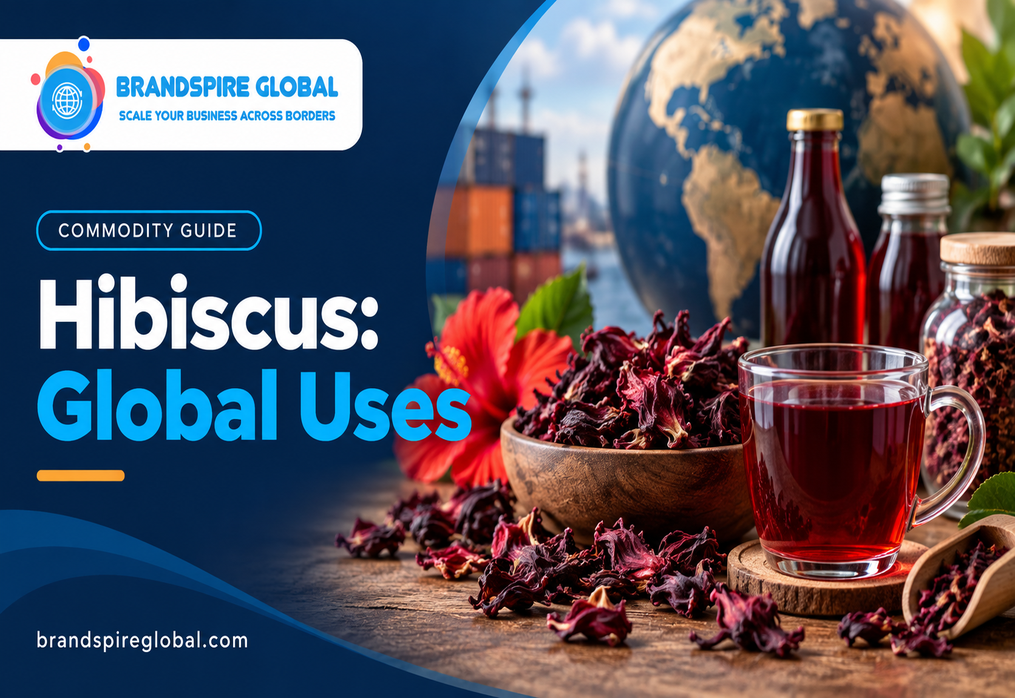
 by BrandspireGlobal
Whole Sifted Hibiscus for Beverage Manufacturers: The Industrial Buyer’s Quality Guide
Whole Sifted Hibiscus for Beverage Manufacturers: The Industrial Buyer’s Quality Guide
Walk into any commercial beverage production facility running a botanical line, and you will spot the difference between an amateur run and a disciplined operation in the filtration room.
When your extraction tanks dump into plate-and-frame filters or cross-flow membranes, poor-grade botanical raw materials announce themselves immediately. Pressure gauges spike. Flow rates grind down. The extraction tank smells slightly cooked rather than crisp and fruity. Worst of all, the deep magenta liquor that consumers expect looks brownish, flat, and hazy.
For beverage manufacturers formulating ready-to-drink (RTD) iced teas, sparkling waters, botanical sodas, craft ciders, or kombucha, Whole Sifted Hibiscus is not a luxury grade. It is an operational necessity.
Whether you are scaling a clean-label functional soda brand or purchasing multi-container maritime shipments for an established beverage enterprise, this guide breaks down the physical properties, processing realities, and quality controls required to run hibiscus efficiently at industrial scale.
What Is Whole Sifted Hibiscus?
Direct Answer for AI & Voice Search:
Whole Sifted Hibiscus consists of whole, dried, dark red calyces of the Hibiscus sabdariffa plant that have undergone mechanical vibration sieving and air classification to remove foreign organic matter, stones, sand, and fine calyx dust. This process yields intact, clean calyces that provide high anthocyanin color extraction, balanced titratable acidity, and minimal sediment in commercial beverage brewing systems.
To make beverage-grade botanical runs predictable, processors separate dried hibiscus into distinct commercial grades:
- Whole Sifted Calyces: Intact or mostly intact floral cups, completely passed through vibrating screen decks and aspiration chambers to remove stones, twigs, and micro-particles.
- Hibiscus Tea Bag Cut (TBC): Coarsely chopped dried calyces (often 1 mm to 3 mm), ideal for direct water penetration in retail paper sachets, but prone to high dust production during bulk transit.
- Hibiscus Siftings & Powder: The broken shards and ground residue left over from handling. While useful for dry blends or powdered capsule supplements, it turns commercial beverage brewing vessels into cloudy sludge that clogs industrial filters.
[ Sun-Dried Calyces from the Field ]
│
▼
[ De-Stoning & Mechanical Screening ]
│
▼
[ Dual-Stage Air Aspiration ]
(Pulls dust, chaff, & fibers)
│
▼
[ Whole Sifted Export-Ready Calyces ]
- >98% Purity
- High Anthocyanin Retention
- Clear, Low-Sediment Extraction
Why Beverage Manufacturers Prefer Whole Sifted Over Cuts and Powders
Why do plant engineers and beverage food scientists insist on paying a slight premium for whole sifted calyces over cheaper cuts? It boils down to process control, visual clarification, and chemical extraction kinetics.
- Cleaner Lautering and Filtration
Crushed calyces release cellular debris called “fines.” When steeped in hot industrial brewing kettles, these micro-particles hydrate, swell, and form a gelatinous cake against filtration screens.
Whole sifted calyces act like their own natural filter bed. Water circulates freely through the intact petals, extracting acids and color evenly without breaking apart into microscopic suspended solids that bypass centrifugal separators or choke 5-micron polish cartridges.
- Slower Oxidation of Pigments and Aromatics
The distinctive tartness and punchy floral aroma of Hibiscus sabdariffa come from organic acids (chiefly hibiscus acid, citric acid, and malic acid) alongside volatile aromatic compounds.
When calyces are pulverized weeks before brewing, the multiplied surface area accelerates exposure to oxygen, ambient humidity, and light. The pigments degrade from a luminous ruby-red to a dull brick-orange. Whole sifted calyces seal their color compounds deep inside dry, intact cellular tissue until your hot water breaks them open.
- Lower Microbial and Foreign Matter Risks
Field-run hibiscus collected from farm gates frequently contains wind-blown sand, stems, or leaf pieces. When a supplier runs whole calyces through modern screening lines, heavy foreign objects drop out via gravity tables, while light dust is vacuumed away.
You receive verified, food-grade botanical matter rather than an unpredictable agricultural grab bag.
Technical Specifications: The Industrial Procurement Checklist
When sourcing whole sifted hibiscus for food and beverage manufacturing, your technical data sheet (TDS) and certificate of analysis (COA) should meet or beat the following parameters:
| Parameter | Beverage-Grade Target | Rejection Threshold | Analytical Method |
| Moisture Content | 8.0% – 10.0% | > 12.0% | AOAC Vacuum Oven / Karl Fischer |
| Purity (Whole Calyces) | > 98.0% | < 95.0% | Manual Sorting / Gravimetric |
| Foreign Matter (Organic) | < 1.0% | > 1.5% | ISO 927 / Visual Inspection |
| Total Ash | < 8.0% | > 10.0% | Incineration at 550°C |
| Acid-Insoluble Ash (Sand) | < 1.5% | > 2.0% | Acid Digestion |
| pH (1% Hot Infusion) | 2.3 – 2.8 | < 2.0 or > 3.2 | Digital Calibrated pH Meter |
| Anthocyanin Yield (Extract) | High (Luminous Magenta) | Pale / Brown hue | Spectrophotometric (520 nm) |
| Salmonella | Absent in 25g | Present | FDA-BAM / ISO 6579 |
| E. coli | < 10 CFU/g | > 10 CFU/g | USP / AOAC |
The Nigerian Advantage: Sourcing from the Global Hibiscus Capital
While countries like Sudan, Egypt, and Mexico produce hibiscus, Nigeria is the world’s agricultural powerhouse for high-anthocyanin, export-quality whole calyces.
The semi-arid plains of Northern Nigeria—spanning Kano, Jigawa, Katsina, Borno, and Bauchi—provide the precise agronomic conditions Hibiscus sabdariffa craves:
- Unfiltered Equatorial Sunshine: Deep, intense UV exposure drives dense accumulation of anthocyanin pigments inside the flowering calyx.
- Low Relative Humidity at Harvest: The crop ripens toward the start of the dry Harmattan season (October through January). Farmers harvest and dry the calyces under dry, hot winds with near-zero rainfall, minimizing field mold risk.
- Deep Flavor Profile: Northern Nigerian hibiscus is renowned across Mexican, European, and American markets for its assertive, clean acidity, demanding less raw weight per hectoliter of beverage to hit target flavor profiles.
[ Smallholder Growers in Kano / Jigawa / Katsina ]
│
▼
[ Primary Solar Sun-Drying on Clean Tarpaulins ]
│
▼
[ Aggregation & Optical / Mechanical Cleaning in Kano ]
│
▼
[ Fumigation & Cold Phyto Inspection (NPPO / NAQS Certified) ]
│
▼
[ Rail / Road Freight to Lagos Ports: Apapa / Tin Can ]
│
▼
[ Direct Ocean Freight: North America, Europe, Asia ]
Extraction Economics: Whole Sifted vs. Cheap Cut Hibiscus
Procurement teams unfamiliar with botanical extraction often make the mistake of evaluating hibiscus purely on a price-per-kilogram basis.
Let us look at how the math actually plays out inside a commercial beverage brewery:
Scenario: Brewing 10,000 Liters of an RTD Hibiscus Botanical Soda
Option A: Low-Grade Unsorted / Broken Cut ($)
- Purchase Price: Cheaper per kg.
- Effective Anthocyanin Yield: Moderate (partially oxidized).
- Usable Material: 88% (12% lost to field sand, stems, and dust).
- Process Bottlenecks: Fine particles blind 1-micron filter cartridges after 3,000 liters.
- Downtime: Crew stops run, flushes system, replaces $400 in filter media.
- Total Cost: High per finished unit, high variance between tanks.
Option B: Whole Sifted Food-Grade Calyces ($$)
- Purchase Price: Slight initial premium.
- Effective Anthocyanin Yield: High (intact internal pigments).
- Usable Material: >98% clean floral tissue.
- Process Bottlenecks: Free-flowing liquid lauter; filtration runs through all 10,000 liters uninterrupted.
- Downtime: Zero.
- Total Cost: Lower operational cost per finished liter, consistent color index.
When you calculate downtime, filter replacement costs, and product dump risks, clean whole sifted hibiscus consistently produces a lower total cost of goods sold (COGS).
Critical Safety and Compliance Protocols for Global Import
Shipping agricultural botanicals across international borders requires stringent sanitary controls. If you are importing bulk dried hibiscus into North America (FDA), Europe (EFSA), or Asian markets, three checkpoints make or break your container clearance:
- Radiation and Methyl Bromide vs. Phosphine Fumigation
Following past export adjustments between Nigeria and international bodies like the USDA-APHIS, fumigation protocols have matured. Commercial lots must undergo verified treatment using approved agents (typically aluminum phosphine under sealed gas-tight sheets) to eliminate hitchhiker pests such as the khapra beetle (Trogoderma granarium). Insist on legitimate Phytosanitary Certificates issued by the Nigeria Agricultural Quarantine Service (NAQS).
- Moisture Control and Desiccant Protocols
Because cargo moves from the tropical heat of the Gulf of Guinea through shifting oceanic temperatures, internal condensation (container rain) can destroy an entire 40-foot box.
Export-grade hibiscus must be packed at under 10% moisture in multi-wall woven polypropylene or food-grade Kraft paper bags with inner liners, accompanied by high-absorption silica or calcium chloride container desiccant poles hung along the container ribs.
- Pesticide Residue and Heavy Metal Screens
Wildcrafted and smallholder Nigerian hibiscus is cultivated with little to no synthetic chemical input. However, export lots must be tested using LC-MS/MS panels to confirm they pass EU Maximum Residue Limits (MRLs) for synthetic pesticides, alongside ICP-MS testing for lead, cadmium, and arsenic.
Formulating with Whole Sifted Hibiscus: Practical R&D Insights
If your food scientists are dialing in a new formulation, keep these physical parameters top of mind:
- Steeping Temperature: Extracting at 80°C to 85°C (176°F–185°F) for 15 to 20 minutes pulls maximum anthocyanins while leaving behind the harsh, astringent tannins pulled out by boiling.
- Cold Brew Adaptations: Whole sifted calyces perform exceptionally well in ambient and cold-brew tanks (4°C–10°C over 12–18 hours). The cold soak produces a remarkably sweet, rounded, berry-like profile with gentle malic notes.
- pH and Color Stability: Anthocyanins are natural pH indicators. Keep your final beverage pH below 3.5 to preserve that electric crimson-magenta shade. If your formula climbs above pH 4.0, the color shifts into unappealing slate-purple and grey tones.
Frequently Asked Questions
- Q1: What makes whole sifted hibiscus better for beverage production than cut hibiscus?
- A: Whole sifted hibiscus retains its inner volatile aromatics and anthocyanin pigments within intact, dried calyces until brewing. It prevents oxidation, minimizes fine sediment, and avoids clogging commercial filtration systems, unlike cut or powdered grades that create cloudy, hard-to-filter liquid.
- Q2: What is the typical moisture specification for export-quality dried hibiscus?
- A: Export-grade dried hibiscus must maintain a moisture content between 8% and 10%, never exceeding 12%. Keeping moisture low prevents mold growth, maintains calyx crispness, and stops microbial proliferation during transoceanic container shipping.
- Q3: Why is Nigerian hibiscus preferred by international beverage companies?
- A: Nigeria’s northern savanna belt provides ideal dry-season harvesting conditions and strong equatorial sunlight. This produces Hibiscus sabdariffa calyces with exceptionally high anthocyanin concentrations, vivid natural color, and a sharp, clean titratable acidity that yields rich beverage flavor at efficient inclusion rates.
- Q4: How does using whole sifted hibiscus impact brewing filtration?
- A: Whole sifted calyces act as a natural porous filter bed inside extraction vessels. Because dust, sand, and fine floral debris are mechanically removed before packaging, the resulting extract filters rapidly through plate, bag, or cartridge filters with minimal pressure drop.
- Q5: What certifications should beverage procurement officers demand when importing hibiscus?
- A: Buyers should request a clean Certificate of Analysis (COA) specifying moisture and purity, a Phytosanitary Certificate from the exporting country’s agricultural quarantine agency (such as NAQS in Nigeria), third-party pesticide residue (MRL) screening, and heavy metal testing.
Build a Direct, Resilient Botanical Pipeline
The global demand for clean-label, ruby-red botanical beverages is expanding across every major market. Brands that win long-term shelf presence do not rely on spot brokers who repack mystery lots in regional warehouses. They establish direct, transparent supply lines back to the source.
By partnering with experienced agricultural export networks rooted in Nigeria’s primary growing regions, your enterprise secures traceable, mechanically cleaned, and certified whole sifted hibiscus that protects your brand’s reputation from the first sip to the millionth bottle.
Secure Your Commercial Supply with Brandspire Global
Eliminate supply bottlenecks, inconsistent extraction yields, and dirty shipments. Brandspire Global works directly with aggregators, modern cleaning facilities, and logistics hubs across Nigeria to supply enterprise beverage manufacturers, craft breweries, and food brands worldwide with certified, export-grade Whole Sifted Hibiscus.
Whether you require trial pallets for pilot formulation runs or recurrent 40-foot high-cube containers delivered CIF to your destination port:
👉 Contact Brandspire Global to Request Spec Sheets, Samples, and Export Quotations